
Capital Expenditure Control Toolkit
(5 customer reviews)A focused collection of 66 professional templates and tools designed to support capital expenditure governance, requests, approvals, budgets, transfers, commitments, spend, forecasts, cash flow, contingencies, changes, business cases, project financial reviews, closure, and post-investment reviews.
- Focused Functional Coverage – Resources specifically aligned with capital expenditure control responsibilities, accounting activities, controls, and records.
- Professional Quality – Ready to Use policies, procedures, models, registers, reconciliations, checklists, dashboards, and reports.
- Fully Editable – Customize all included Word, Excel, and PowerPoint resources to match your accounting policies, systems, terminology, and branding.
- Operationally Practical – Use daily, weekly, monthly, and annual or periodic tools to support recurring finance operations and review.
- Save Time & Cost – Accelerate finance documentation and control implementation without creating every file from the beginning.
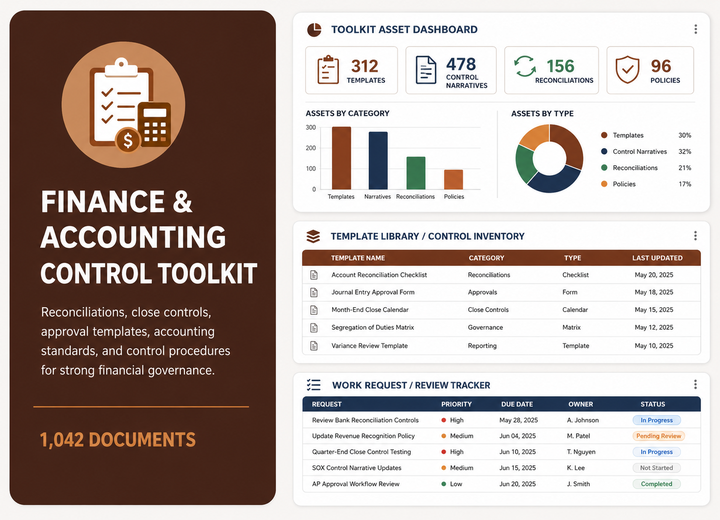
Capital Expenditure Control Toolkit
The Capital Expenditure Control Toolkit is a focused, editable documentation package designed to help organizations establish, operate, control, monitor, and continually improve capital expenditure control practices.
The toolkit combines coordinated policies, procedures, manuals, models, registers, reconciliations, control tools, dashboards, reports, checklists, and training materials covering capital expenditure governance, requests, approvals, budgets, transfers, commitments, spend, forecasts, cash flow, contingencies, changes, business cases, project financial reviews, closure, and post-investment reviews.
Who This Capital Expenditure Control Toolkit Is For
This toolkit is suitable for organizations that require disciplined, controlled, accurate, auditable, and scalable practices for capital expenditure control.
- Capital controllers
- Investment committees
- FP&A and finance teams
- Project finance professionals
- Capital project sponsors
- Finance risk, compliance, and internal-audit professionals
- ERP, data, and finance-systems teams
- Shared-services and process-excellence leaders
- Consultants designing finance operating models
- Organizations preparing for audits, transformation, or control improvement
Why Choose These Capital Expenditure Control Templates
The Capital Expenditure Control Toolkit helps organizations standardize finance processes, strengthen controls, improve data quality and reporting, support auditability, and accelerate implementation across capital expenditure control.
Toolkit Document Index
Below is the complete structured index of 66 files in 1 folder. The section is open by default and contains 17 Word, 47 Excel, and 2 PowerPoint resources.
 Capital Expenditure Control
 Capital Expenditure Policy.docx Capital Expenditure Control Procedure.docx Capital Request Procedure.docx Capital Approval Procedure.docx Capital Budget Transfer Procedure.docx Capital Commitment Control Procedure.docx Capital Project Financial Control Procedure.docx Post-Investment Review Procedure.docx
 Capital Approval Matrix.xlsx Capital Expenditure Calendar.xlsx Capital Request Register.xlsx Approved Capital Budget.xlsx Capital Commitment Register.xlsx Capital Spend Register.xlsx Capital Forecast Model.xlsx Capital Project Cash Flow.xlsx Capital Budget Variance Tracker.xlsx Capital Contingency Register.xlsx Capital Change Register.xlsx Capital Business Case.docx Capital Request Form.docx Capital Budget Transfer Form.docx Capital Change Request Form.docx Capital Project Financial Review.xlsx Capital Project Closure Form.docx Post-Investment Review Template.docx Capital Approval Checklist.xlsx Capital Commitment Checklist.xlsx Capital Control Matrix.xlsx Capital Expenditure KPI Dashboard.xlsx
 Capital Control Training Slides.pptx Capital Controller Competency Matrix.xlsx Capital Expenditure Implementation Guide.docx Function Objectives and KPI Register.xlsx Function Risk Register.xlsx Function Issue Register.xlsx Function Action Tracker.xlsx Function Training Matrix.xlsx Function Document Register.xlsx Function Record Retention Schedule.xlsx Function Business Continuity Plan.docx Function Handover Checklist.xlsx Function Competency Assessment.xlsx Daily Capital Request Log.xlsx Daily Capital Commitment Log.xlsx Daily Capital Spend Log.xlsx Daily Capital Issue Log.xlsx Daily Capital Action Tracker.xlsx Weekly Capital Spend Review.xlsx Weekly Capital Commitment Review.xlsx Weekly Capital Forecast Review.xlsx Weekly Capital Change Review.xlsx Weekly Capital Project Review.xlsx Monthly Capital Expenditure KPI Dashboard.xlsx Monthly Capital Spend Report.xlsx Monthly Capital Forecast Report.xlsx Monthly Capital Variance Report.xlsx Monthly Capital Project Report.xlsx Monthly Capital Review Pack.pptx Annual Capital Expenditure Plan.xlsx Annual Capital Portfolio Review.docx Annual Post-Investment Review Plan.xlsx Capital Expenditure Internal Audit Checklist.xlsx Capital Expenditure Maturity Assessment.xlsx Capital Expenditure Improvement Tracker.xlsx Annual Capital Control Training Plan.xlsx
Frequently Asked Questions - Capital Expenditure Control Toolkit
1. Who is the Capital Expenditure Control Toolkit designed for?
It is suitable for capital controllers, investment committees, FP&A and finance teams, project finance professionals, and capital project sponsors, as well as organizations establishing or improving controlled finance practices in this area.
2. What is included in the Capital Expenditure Control Toolkit?
The package contains 66 editable resources organized in one folder, covering capital expenditure governance, requests, approvals, budgets, transfers, commitments, spend, forecasts, cash flow, contingencies, changes, business cases, project financial reviews, closure, and post-investment reviews.
3. Which file formats are included?
The toolkit includes 17 DOCX, 47 XLSX, and 2 PPTX.
4. Can the templates be customized?
Yes. The included files can be adapted to your organization’s terminology, accounting policies, control environment, approval authorities, reporting calendar, systems, branding, and local requirements.
5. Does the toolkit provide a structured framework for capital expenditure control?
Yes. It includes relevant policies, procedures, manuals, models, registers, checklists, controls, reports, and implementation resources where applicable.
6. Are registers, matrices, models, and trackers included?
Yes. The toolkit includes practical registers, matrices, analytical models, reconciliations, trackers, calendars, and working papers.
7. Are forms, checklists, and approval tools included?
Yes. Editable forms, review checklists, approval templates, control checklists, and evidence tools are included for practical implementation.
8. Does the toolkit include dashboards and management reports?
Yes. It includes KPI dashboards, operational reports, control reports, review packs, trend analyses, and presentation materials relevant to the function.
9. Are daily operational tools included?
Yes. Daily logs and trackers are included for transactions, requests, issues, exceptions, decisions, actions, evidence, or operational updates relevant to the function.
10. Are weekly management tools included?
Yes. Weekly reviews, reconciliations, exception reviews, risk reviews, work plans, and short-cycle management tools are included.
11. Are monthly oversight tools included?
Yes. Monthly dashboards, performance reports, variance reports, control reports, and management-review packs are included.
12. Are annual or periodic planning and review tools included?
Yes. Annual plans, process reviews, audit checklists, maturity assessments, training plans, and improvement trackers are included where relevant.